Form Follows Fortune: A Candid Appraisal of the Architectural Styles Shaping Park City's Luxury Market
There is a particular danger in purchasing real estate by aesthetic impulse alone. A home that photographs magnificently on an Instagram feed may perform poorly in a high-altitude Utah winter, attract a narrow pool of future buyers, or require maintenance costs that quietly erode its investment thesis. In Park City's luxury segment—where transaction values routinely reach seven figures and beyond—the architectural style of a property is not a superficial consideration. It is a financial variable.
At Park City AV, we have observed the full spectrum of design philosophies that currently define the upper tier of the local market. What follows is an honest, experience-informed appraisal of the five most prevalent styles, written not to flatter any particular aesthetic but to help buyers invest with confidence rather than sentiment.
Contemporary Mountain Modern: The Market's Dominant Force
Contemporary mountain modern has become the defining idiom of Park City luxury construction over the past decade, and for good reason. Characterized by clean geometric lines, expansive glazing, reclaimed wood and steel accents, and seamless indoor-outdoor transitions, this style represents a sophisticated synthesis of modernist design principles and mountain materiality.
From a market performance standpoint, contemporary mountain modern commands the strongest buyer demand across the widest demographic range. Younger affluent buyers drawn to Deer Valley's newly expanded terrain respond to its minimalist sensibility, while established collectors of fine properties appreciate the quality of craftsmanship typically associated with its execution. Resale velocity for well-built examples in desirable locations is consistently strong.
The practical advantages are equally compelling. Large south-facing windows are not merely dramatic—they harvest passive solar gain that meaningfully reduces heating loads during Park City's extended winter season. Metal rooflines shed snow efficiently. Contemporary detailing tends to age more gracefully than ornamental styles that can begin to feel dated within a single decade.
The caution: not all contemporary mountain modern construction is created equal. Inferior execution—thin wall assemblies, inadequate thermal bridging mitigation, or value-engineered glazing packages—can result in a home that looks the part but underperforms energetically. Buyers should scrutinize mechanical specifications and insulation standards with the same attention given to countertop selections.
Ski Lodge Rustic: Enduring Charm With Maintenance Caveats
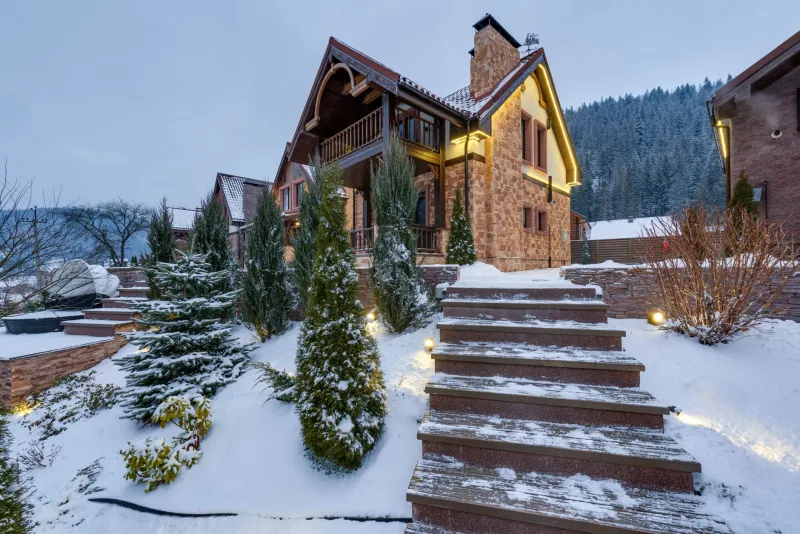
The ski lodge aesthetic—heavy timber framing, stacked stone fireplaces, vaulted great rooms, and warm-toned wood paneling—carries an emotional resonance that no other style quite replicates. For many buyers, it is the Platonic ideal of a mountain home, and the Park City market contains magnificent examples that deliver on that promise.
Ski lodge rustic properties hold their value reliably, particularly when the craftsmanship is genuine rather than applied. Structural timber frames, hand-hewn stone, and custom ironwork speak to permanence in ways that attract a consistent buyer cohort. Vacation rental performance for this style is frequently exceptional—guests seeking an archetypal mountain escape respond enthusiastically to its visual warmth.
However, prospective buyers must enter this segment with clear eyes about maintenance realities. Exposed wood elements require regular treatment to resist UV degradation and moisture intrusion at elevation. Older examples may have insulation standards that fall well below contemporary expectations, resulting in heating costs that are difficult to justify. Log construction, in particular, demands expertise from contractors familiar with the specific behavior of that building system.
The recommendation: engage a qualified inspector with demonstrated experience in timber-frame and log construction before proceeding. The right property in this style is a genuine joy to own; the wrong one becomes a recurring obligation.
European Manor Influence: A Niche With Limited Liquidity
A subset of Park City's luxury inventory draws inspiration from European precedents—French chateau detailing, Tuscan stone facades, formal symmetry, and ornamental ironwork. These properties are often genuinely beautiful and represent substantial construction investments. They are also the most difficult style to resell in this particular market.
The fundamental misalignment is contextual. Park City's identity is rooted in Western mountain culture, ski heritage, and natural landscape. A Provençal-inspired manor, however impeccably executed, exists in a kind of cultural friction with its surroundings that sophisticated buyers tend to sense even when they cannot articulate it. The buyer pool for this style is narrower, transaction timelines tend to be longer, and price negotiations more significant.
For buyers who intend to hold a property as a personal retreat indefinitely and for whom resale timeline is irrelevant, a European manor-influenced home may deliver genuine personal satisfaction. For those who view the acquisition as a financial asset with an eventual exit, the liquidity constraints of this style represent a real risk that should be priced into the offer.
Mid-Century Modern: A Cult Following With Geographic Limits
Mid-century modern architecture—defined by flat or low-pitched rooflines, post-and-beam construction, floor-to-ceiling glass, and organic integration with the landscape—has experienced a significant national revival. In markets such as Palm Springs, it commands extraordinary premiums. In Park City, the picture is more nuanced.
Authentic mid-century modern examples in Park City are relatively rare, given that the town's significant development occurred largely after that era's peak. Contemporary interpretations of the style exist, and they can be compelling—particularly when sited to maximize mountain views through their characteristic expanses of glass. However, flat and low-pitched rooflines present real-world challenges in a climate that regularly deposits several feet of snow. Engineering solutions exist, but they add cost and complexity.
The buyer for whom mid-century modern is a genuine architectural passion—rather than a trend-driven preference—will find opportunity in Park City, particularly at price points where the style is not yet fully recognized by the broader market. Those seeking straightforward appreciation dynamics may find contemporary mountain modern a more reliable vehicle.
Sustainable Luxury: The Style With the Strongest Long-Term Trajectory
The most interesting architectural conversation currently occurring in Park City's luxury segment involves sustainability—not as a marketing designation, but as a design philosophy that integrates passive house principles, net-zero energy systems, geothermal heating, and regenerative material sourcing into genuinely beautiful homes.
This category does not yet represent the majority of luxury inventory, but its trajectory is unmistakable. Buyers in their thirties and forties—the demographic that will define Park City's market for the next two decades—increasingly evaluate properties through an environmental performance lens alongside traditional criteria. Utility cost transparency, HERS ratings, and third-party green certifications are becoming relevant data points in high-end transactions.
From a financial perspective, sustainable luxury properties carry higher construction costs that are not always fully recovered at initial resale. The long-term thesis is more compelling: as energy costs rise and environmental standards tighten, properties that perform efficiently will carry a durable premium over those that do not. Buyers who acquire a well-executed sustainable luxury home today are likely positioning themselves favorably for a market that will look meaningfully different in ten years.
The Architecture-Investment Alignment
The most important insight across all five categories is this: the best architectural choice is not the one that generates the most admiration at a dinner party. It is the one that aligns the buyer's personal use priorities with a realistic assessment of resale dynamics, climate performance, and maintenance economics.
Park City AV's advisors work with buyers to evaluate properties not only for their present appeal but for their long-term fitness. Architecture is a permanent decision—and in this market, it deserves permanent consideration.