Beyond the Beaten Path: Park City's Emerging Neighborhoods Are Quietly Rewriting the Investment Playbook
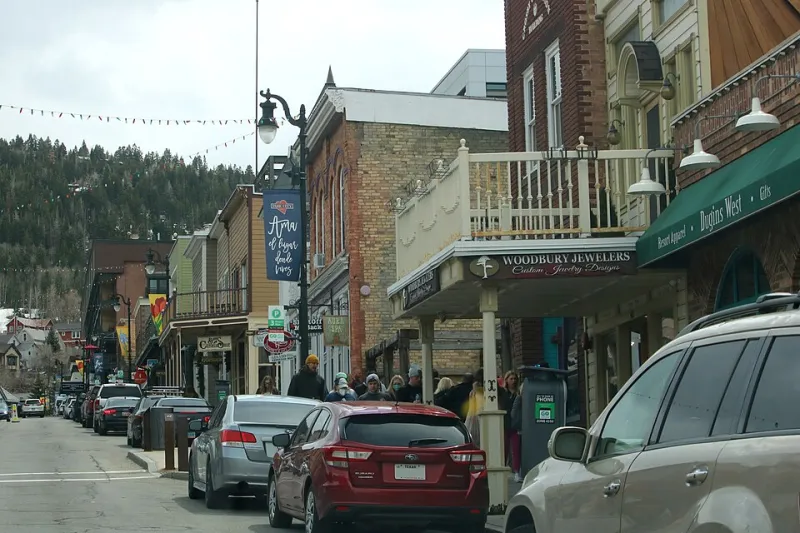
Photo: claralieu, CC BY 2.0, via Wikimedia Commons
For years, the conversation around Park City real estate has centered on the same familiar addresses: the historic Victorian storefronts of Old Town, the ski-in/ski-out compounds of Deer Valley, and the gated estates of Promontory. These are trophy assets — enduring, prestigious, and priced accordingly. But a quieter story is unfolding just beyond those well-worn corridors, one that seasoned investors are increasingly paying attention to.
Park City's secondary market — neighborhoods that lack the marquee name recognition of their counterparts but offer genuine lifestyle appeal and measurable growth fundamentals — has begun attracting a different caliber of buyer. These are not opportunists chasing a quick flip. They are long-horizon investors who understand that the most significant appreciation often precedes the spotlight, not follows it.
Why the Secondary Market Is Gaining Traction
Several forces are converging to make Park City's emerging neighborhoods more attractive than at any point in recent memory. Remote work has fundamentally altered the calculus for second-home buyers, many of whom now treat mountain properties as primary residences for extended stretches. Meanwhile, Summit County's short-term rental regulations have matured to a point where investors can plan with greater regulatory certainty. And perhaps most significantly, the sheer velocity of price appreciation in Deer Valley and Old Town has pushed first-time luxury buyers to expand their geographic aperture.
According to data compiled by the Park City Board of Realtors, median home prices in Park City's primary luxury enclaves rose approximately 38 percent between 2020 and 2024. In several secondary neighborhoods, however, appreciation over the same period tracked closer to 44 to 51 percent — a counterintuitive outcome that reflects the compounding effect of low baseline valuations meeting surging demand.
Snyderville Basin: The Quiet Achiever
Few neighborhoods better illustrate the secondary market's potential than Snyderville Basin, the broad residential corridor stretching west of Park City proper toward Interstate 80. Long regarded as the practical alternative to Old Town's premium pricing, Snyderville has undergone a quiet but unmistakable transformation.
"We're seeing buyers who five years ago would have looked exclusively at Deer Valley now seriously evaluating Snyderville Basin," says one Park City-based broker with over two decades of local market experience. "The infrastructure has caught up — the schools are excellent, the trail access is legitimate, and the commute into Park City proper is negligible."
Median single-family home prices in Snyderville Basin currently range from approximately $1.1 million to $2.3 million depending on proximity to ski access and acreage. Gross rental yields for well-positioned short-term rental properties have been reported in the 7 to 9 percent range by property managers operating in the area — figures that meaningfully outperform comparable assets in more saturated luxury sub-markets.
Kimball Junction: Infrastructure-Driven Appreciation
Located at the northern gateway to Park City, Kimball Junction has historically been viewed as a commercial node — the place where visitors stop for groceries before heading up the mountain. That perception is changing rapidly. A wave of residential development, anchored by improved retail amenities and direct freeway access, has repositioned Kimball Junction as a legitimate residential destination.
Condominium inventory in this area — particularly in developments built within the last decade — offers an entry point into the Park City market that remains below $700,000 in many cases. For investors focused on short-term rental income, the proximity to both Park City Mountain Resort and the Utah Olympic Park creates a diversified demand base that extends well beyond ski season.
Local property managers note that Kimball Junction units with dedicated parking and updated interiors are achieving occupancy rates of 68 to 74 percent on an annualized basis — a figure that compares favorably to properties at twice the acquisition cost in more central locations.
Quinn's Junction and the Jordanelle Corridor
Perhaps the most compelling emerging story in the Park City secondary market involves the Jordanelle Reservoir corridor, spanning from Quinn's Junction eastward toward Heber City. The completion of the Mayflower Mountain Resort — a Extell Development project that represents one of the most significant ski resort expansions in Utah's history — has fundamentally altered the investment thesis for properties in this zone.
"The Jordanelle corridor is where I'm directing clients who have a five-to-ten-year investment horizon," notes one Summit County investment specialist. "When Mayflower opens at full capacity, you're going to see demand for proximate short-term rentals that this market simply cannot currently satisfy. The supply-demand imbalance will be significant."
Land parcels and new construction opportunities remain available in this corridor at prices that would be unthinkable in established Park City neighborhoods. Developers have taken notice: several planned unit developments targeting the $800,000 to $1.5 million range are currently in various stages of entitlement and construction.
Silver Creek Village: The Long Game
For investors with the patience and capital to play a longer development arc, Silver Creek Village warrants serious consideration. Situated northeast of Park City along State Route 248, Silver Creek represents one of the last large-scale mixed-use development opportunities in Summit County. Master-planned with a combination of residential, commercial, and community amenity uses, Silver Creek Village is designed to function as a self-contained neighborhood rather than a bedroom community.
Current pricing for residential lots and early-phase construction within Silver Creek Village reflects the inherent uncertainty of a project still in its formative stages. That uncertainty, however, is precisely the source of the opportunity. Investors who entered comparable master-planned communities in the Wasatch Back during their early phases have, in several documented cases, realized appreciation in excess of 60 percent over seven-year holding periods.
A Note of Measured Optimism
No investment thesis is without risk, and Park City's secondary market is no exception. Regulatory changes affecting short-term rentals, shifts in remote work patterns, and broader macroeconomic conditions all have the capacity to affect the trajectory of appreciation in these neighborhoods. Prospective investors are strongly encouraged to engage with licensed local real estate professionals who possess current, granular market knowledge before making acquisition decisions.
What the data does suggest, however, is that the window of relative accessibility in Park City's emerging neighborhoods is narrowing. The same infrastructure improvements, lifestyle amenities, and proximity to world-class recreation that made Old Town and Deer Valley legendary are now accruing — at an accelerating pace — to the neighborhoods that surround them. For investors willing to look beyond the familiar, the opportunity is genuine and, in all likelihood, time-sensitive.