The True Cost of Transformation: Why Renovating a Park City Luxury Home Often Defies the Budget
The calculus seems straightforward enough. A home in a desirable Park City neighborhood, built in the 1980s or early 1990s, hits the market at a price that reflects its dated interiors and deferred maintenance. A buyer with vision — and a contractor's number saved in their phone — sees an opportunity: acquire the property at a relative discount, invest in a comprehensive renovation, and emerge with a luxury residence that rivals new construction at a fraction of the cost.
It is a compelling thesis. It is also, in the current Park City construction environment, one that demands rigorous scrutiny before any earnest money changes hands.
The Baseline Problem: What "Luxury Renovation" Actually Costs in Park City
The term "luxury renovation" is deployed liberally in real estate conversations, but in Summit County, it carries a specific and sobering price point. Industry professionals with active projects in the Park City area consistently report all-in renovation costs — encompassing structural work, mechanical systems, finishes, and project management — in the range of $300 to $600 per square foot for projects that meet contemporary luxury standards.
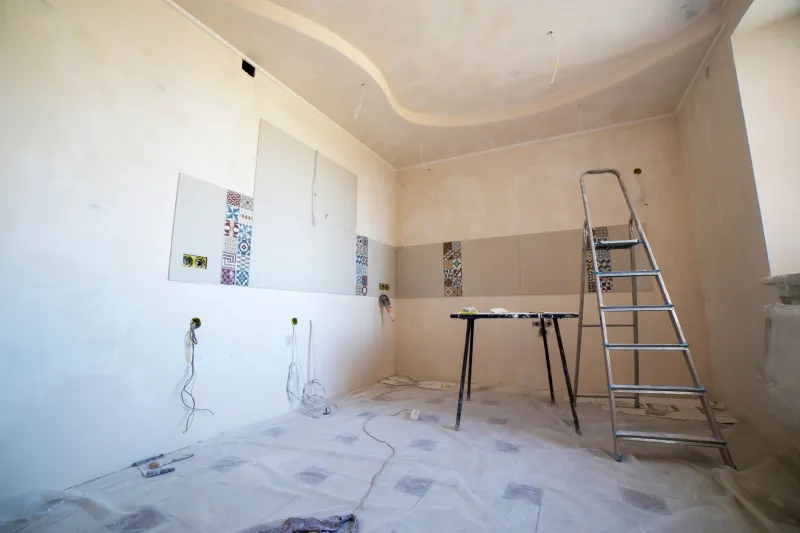
At the lower end of that range, a buyer is typically addressing cosmetic updates: new flooring, kitchen and bathroom refreshes, updated lighting, and exterior paint. At the upper end, they are undertaking what amounts to a gut renovation — replacing HVAC systems, rewiring electrical panels, updating plumbing, reconfiguring floor plans, and installing the high-specification finishes that today's luxury buyer expects as a baseline.
For a 4,000-square-foot home, the arithmetic is unambiguous. A full luxury renovation could easily represent a $1.5 million to $2.4 million investment on top of the acquisition cost. In a market where move-in-ready comparables may trade at only a modest premium over a dated property, the financial rationale for renovation requires careful analysis rather than optimistic assumption.
Labor: The Constraint That Overrides Every Other Variable
Material costs, while elevated relative to pre-2020 baselines, have stabilized in many categories. Labor has not. Park City's construction workforce faces structural constraints that are unlikely to resolve in the near term.
The region's high cost of living — driven in large part by the very real estate market that generates renovation demand — makes it economically challenging for skilled tradespeople to reside locally. Many contractors and subcontractors commute from Salt Lake City, Heber City, or communities further afield, a dynamic that adds both cost and scheduling complexity to every project. Electricians, plumbers, finish carpenters, and tile setters with luxury-level capabilities are in genuinely short supply, and their availability does not expand proportionally with demand during peak construction periods.
The practical consequence is that project timelines routinely extend beyond initial estimates. A renovation projected to require eight months frequently stretches to twelve or fourteen, and each month of extension carries real costs: carrying costs on the acquisition loan, temporary housing expenses, and the compounding effect of any scope changes that arise during construction.
Summit County Permitting: A Timeline Variable That Demands Respect
Permitting delays represent one of the most consistently underestimated variables in Park City renovation budgets. Summit County's building department, while professional and thorough, operates under its own timeline — one that does not necessarily align with a buyer's vision for a spring completion or a first-season rental launch.
Historic properties, of which Park City has a meaningful inventory, introduce an additional layer of complexity. Work that might proceed without comment in a newer subdivision can trigger historical preservation review when the subject property sits within or adjacent to a designated historic district. Exterior alterations, in particular, can require approvals from multiple entities before a permit is issued.
Buyers who have not accounted for a three-to-six-month permitting timeline in their project planning frequently find themselves adjusting their financial models mid-process. The cost of that adjustment — in both dollars and personal frustration — is difficult to fully anticipate in advance.
Case Illustration: When the Numbers Worked, and When They Did Not
Consider two scenarios representative of projects in the Park City market in recent years.
In the first, a buyer acquired a 3,200-square-foot home in the lower Deer Valley area for $1.85 million. The property was structurally sound, with functional mechanical systems that required updating rather than replacement. The renovation scope was disciplined: new kitchen, updated bathrooms, refinished hardwood floors, and a deck addition. Total renovation cost came in at approximately $380,000 over a nine-month timeline. The finished property was subsequently listed and sold at $2.9 million, yielding a meaningful return on the combined investment.
In the second scenario, a buyer acquired a comparable-sized property in Old Town for $1.6 million, attracted by its location and the apparent simplicity of a cosmetic renovation. Upon opening walls, the project team discovered knob-and-tube wiring throughout, galvanized plumbing nearing the end of its serviceable life, and substandard insulation inconsistent with current energy codes. What began as a $250,000 renovation budget expanded to $720,000 over a fourteen-month timeline. The final sale price, while respectable, produced a return that a straightforward purchase of a turnkey property in the same neighborhood would have matched with considerably less effort.
The Turnkey Versus Renovation-Ready Decision Framework
The decision between purchasing a turnkey property and a renovation-ready one is not reducible to a simple formula, but several principles consistently hold.
Buyers who have not previously managed a luxury renovation in a mountain environment — with its attendant logistical challenges, seasonal construction windows, and regulatory complexity — should approach renovation-ready properties with particular caution. The learning curve is real, and the cost of that education is paid in project overruns.
Conversely, buyers with established contractor relationships, realistic timelines, and genuine flexibility on occupancy dates can find compelling value in properties that the broader market has priced based on their current condition rather than their potential. The opportunity exists; it simply demands a more disciplined analytical approach than the renovation narrative typically encourages.
For investment-oriented buyers considering renovation as a precursor to vacation rental income, the calculus must also account for the revenue foregone during the renovation period — a factor that can materially alter the project's apparent ROI when modeled honestly.
A More Informed Point of Entry
Park City's luxury renovation market rewards preparation and penalizes assumption. Buyers who commission thorough pre-purchase inspections, obtain contractor estimates before closing rather than after, build genuine contingency reserves into their budgets, and approach permitting timelines with patience rather than optimism will find that renovation-ready properties can represent legitimate value.
Those who proceed on the basis of back-of-envelope arithmetic and optimistic timelines will, with considerable regularity, find that the mountain has its own ideas about schedules and budgets.